Xi Jinping’s Great Purge: What’s Happening in the Chinese Army?
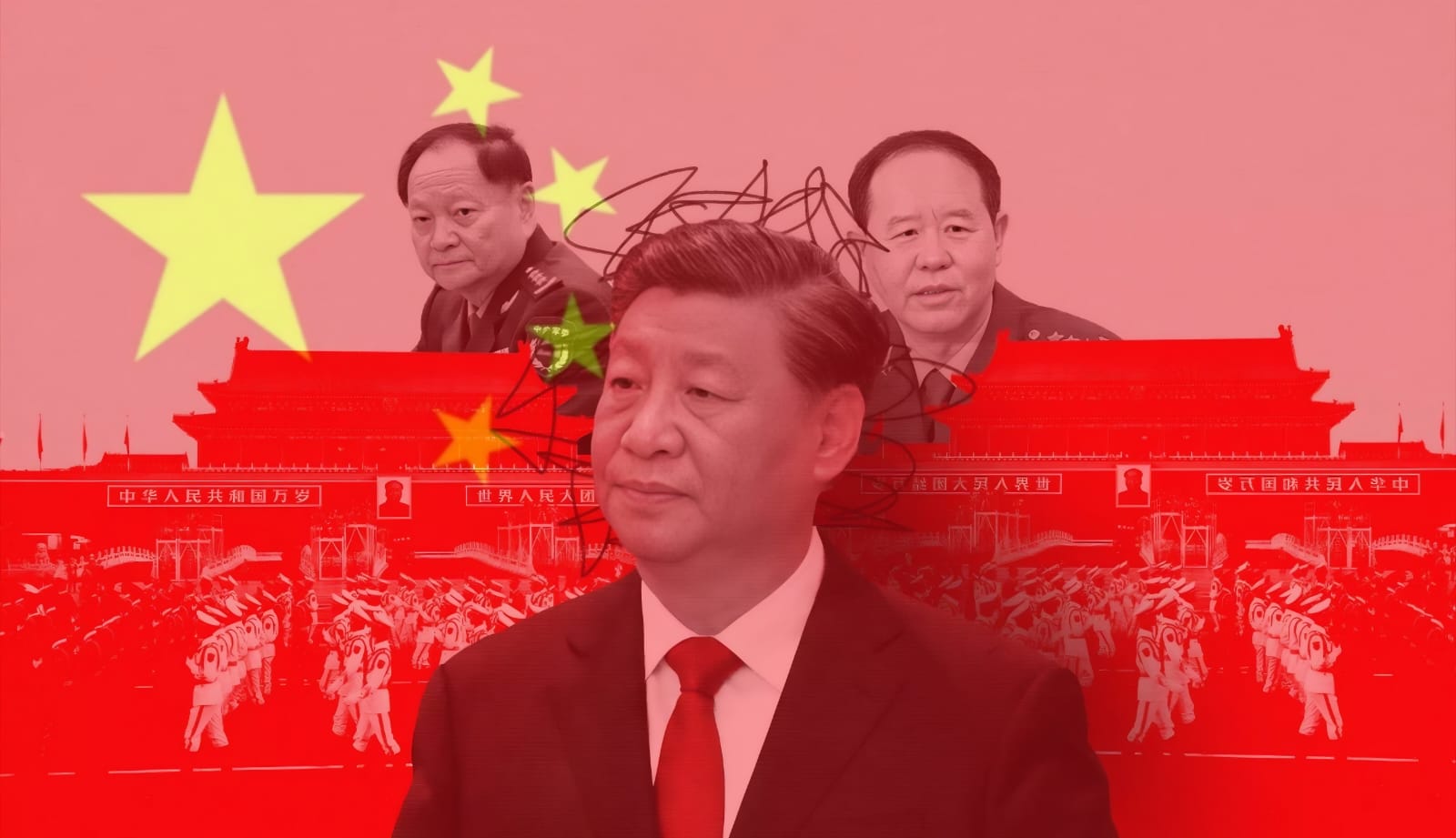

In January 2026, Zhang Youxia, a member of the Central Military Commission of the People’s Republic of China and the country’s most prominent general, was purged. Combined with the purges in previous months, this left only 2 members in the normally 7-member commission: Xi Jinping himself and Zhang Shengmin. The official publication of the army, PLA Daily, attributes the purges to corruption and indiscipline.
This sudden vacancy in the leadership of the People’s Liberation Army (PLA) has led to much speculation. Some interpret this as a coup attempt against Xi’s power, while others link the purges to China’s potential invasion of Taiwan. Looking at the second group, we see two conflicting ideas: some believe these purges will lead to rejuvenation in military leadership and an increase in China’s military aggression, while others assume that the PLA’s operational capacity will be restricted and a potential invasion delayed.
Before delving into such speculations and exaggerated theories, it is necessary to understand the nature of army-politics relations in China.
“Political power grows out of the barrel of a gun.” Mao-Era Civil-Military Relations
After the founding of the People’s Republic of China, military elites played an active role in the country’s politics. In countries where the army is an active actor in politics, the army typically oversteps its bureaucratic boundaries to push civilian administration in a certain direction or directly overthrow it. In China, however, despite the active role of soldiers in politics, the party’s hegemony over the country has always remained solid, and the military has somehow always remained loyal to party authority.
For example, in the 1953 Gao Gang case, when military and civilian elites clashed for the first time, the army ultimately bowed to party authority. In 1959, when war hero Marshal Peng Dehuai criticized Mao’s Great Leap Forward policies and found support within the party, he and his close officers were eventually purged, and the army again submitted to party leadership.
In 1967, during the Cultural Revolution, the PLA directly confronted the Red Guards and used armed force for the first time in such disputes. Despite their extensive influence and power in both the central government and provincial administrations at the time, the army did not use this as an opportunity to seize power. Or, when soldiers reached the peak of their political power with Lin Biao, they showed no resistance when purged from cadres after Lin Biao’s death. The alleged coup by Lin Biao, if successful, would have been carried out not in the name of the army but in the name of the party. And most importantly, although the Chinese army directly overthrew the Gang of Four with a coup after Mao’s death, this coup was carried out in collaboration with civilian elites, and the army did not attempt to replace Hua Guofeng, who was in a politically sensitive position.
To understand the army’s loyalty to the CCP, we may need to provide a bit more information about the Gang of Four case. In the process leading to the end of the Cultural Revolution, Mao’s political power had suffered serious damage. The sudden transformation of Lin Biao, whom Mao had chosen and elevated as his successor, into the leader of a “counter-revolutionary organization” in regime propaganda had raised questions about the Cultural Revolution and Mao’s leadership.

With the loss of Lin, ties with the army were severed; with the loss of the Red Guards, armed power was lost; with Mao’s death, the greatest symbols were lost; and facing opposition both within the CCP and in society against their policies, the Maoist Gang of Four was overthrown by the army, which had actually created the necessary conditions for the elimination of the Maoist regime in China. But the army chose to continue the party regime instead of changing it
.So, what is the root of this loyalty despite such an active role in politics? To understand this, we can use the three army-politics relations models from Fang Zhu’s book “Gun Barrel Politics.”
Our first model is the “Liberal Model” seen in Western societies. This model is familiar to people today, where the army and civilians respect each other’s boundaries and only speak on matters concerning themselves. Military elites generally express opinions on issues like the army budget, military readiness, national security matters, and crossing these boundaries is seen as a major crime.
The second model is seen in Eastern European communist regimes, where the party enters the army through ideological indoctrination. In this model, the regime suppresses the army and eliminates its autonomy by placing control mechanisms such as political commissars and intelligence activities, making it loyal to the regime.
Mao’s China fits neither model. The army is neither professionally distant from politics as in Western regimes nor subdued by civilian elites as in Eastern European regimes. Therefore, a third model is proposed to define China: the Neo-Traditional or Symbiosis Model.
According to Mao Zedong, political power grows out of the barrel of a gun. This idea makes sense when considering how the Chinese Communist Party came to power in China. It is difficult to make a clear distinction between China’s military and civilian elites because the founding cadre of the country fought on fronts against both the Kuomintang government and Japan for many years on the path to power. Many civilian elites come from military backgrounds, and as a natural result of this blurry distinction between civilian and military elites, these two types of elites are intertwined.
Similar to the second model, there is serious ideological indoctrination in the Chinese army, but this indoctrination has not been used to make them submit to politics; on the contrary, soldiers’ direct involvement in politics has been encouraged. While the party membership rate among officers is 100%, we also see a significant concentration of military representation in the Politburo or the Central Committee.
The relations among elites in the Mao era transcended traditional bureaucratic boundaries. The regime’s legitimacy and relations among elites were based on personal “comradeship” bonds formed on the battlefield during the path to revolution.
The reason this model is called Neo-Traditional is that it is likened to pre-modern Europe. While there was an ambiguous distinction between civilian and military elites, despite every struggle among these elites, they remained loyal to the monarchy as an institution. In China, no matter what factionalism or origins, every elite in conflict with each other has defended the party as the main institution in their interests.
Politicized military elites have prioritized the party’s interests over the institutional interests of the military, and the same applies to civilian elites. For example, Lin Biao’s choices to increase the army’s weight in politics seriously weakened the military institutionally in terms of war readiness, but the military elite did not mind this, placing party interests ahead of army interests. Moreover, the politicization of the military elite involved them in intra-party factionalism, preventing the existence of a unified military elite directly intervening in politics, thus strengthening the party’s control over the army.
Reform and Professionalization
As the generations forming the leadership of the People’s Republic of China have rejuvenated, the fundamental conditions shaping Mao-era army-civilian relations have begun to disappear. The new generation of Chinese elites does not possess the networks shaped by the revolutionary process that the previous ruling elite had. As a natural result, the distinction between military and civilian elites has become clearer, and bureaucratic boundaries have begun to be drawn, unlike in the Mao era.
In the reform era, the PLA’s involvement in economic activities, its technological lag behind other armies of the era, and similar reasons created a need for the army’s professionalization. Especially the 1979 war between China and Vietnam exposed the PLA’s deficiencies, underscoring the necessity of reform in the army.
When Deng Xiaoping gained authority over China, he made intensive efforts to professionalize the PLA and disperse factionalisms. Deng also ensured that Jiang Zemin had institutionalized authority over the army, making Zemin the first civilian leader of the PLA in history.

The troop strength, which was 4.5 million in the 1970s, was reduced to 3 million by the 1980s. Professional military education, technological investments, and doctrinal changes accelerated. Especially after the Gulf War, reforms in the army sped up, with budget adjustments made to adapt to high-tech warfare.
With these reforms ongoing since the 1980s, the army has withdrawn from commercial activities, and the PLA’s representation in the Politburo has gradually decreased. Seen as the armed wing of the party, the army has been removed from being an active actor in politics due to corruption investigations, and its focus has completely shifted to external issues like the South China Sea and Taiwan.
With Xi Jinping’s rise to power, these reforms have accelerated. As head of the Central Military Commission, Xi has undertaken significant restructuring in the army, expanding the navy, air force, and rocket forces while continuing to shrink the ground forces. Over 100 senior officers have been purged through anti-corruption operations.
The Chinese army has been transformed from a politicized, mass-mobilization army into a professional one that serves China’s current regional and even global ambitions. However, party-army relations have not been completely severed, and the army is still the party’s army, not the state’s.
Recent Military Purges
As we have talked about earlier, the purging of high-level generals in China is not a new phenomenon, but the current purges are the largest since the Mao era. Zhang Youxia being one of the generals most loyal to Chinese President Xi, even a direct family friend, shows that these purges can target anyone.
Despite the professionalization in the army, families of former ruling elites can still take key roles in the party. Youxia is one of them. Zhang Youxia’s father fought alongside Xi Jinping’s father as part of the army during the Chinese Communist Party’s wars against the Kuomintang and Japan, and they were direct participants in the revolutionary process. Additionally, Youxia is one of the few generals who has seen active combat, having fought in the China-Vietnam war.
So, why might such a figure have been purged? Before discussing this, we should note that China’s internal affairs are like a black box. It is not easy for accurate information about what is happening in this country to reach us, and all circulating news should be approached cautiously. Expecting transparency and honesty from China’s official organs due to the regime’s nature is as naive as trusting the claims of exiled dissidents opposed to the regime.
First, the officially stated reason, corruption, does not seem unreasonable at all. Due to his position, Youxia had significant power in lower-level appointments and promotions, and he may have abused his power for personal gain. In general, one of the most logical reasons for these purges could be Xi Jinping’s dissatisfaction with recent lower-level appointments and promotions.
Of course, this does not mean the purges are simple and meaningless, as party propagandists claim. A purge of this magnitude targeting the PLA leadership will certainly cause serious damage to the army’s operational capacity, and the need to purge such big names from the start shows that the internal situation is not as positive as portrayed externally.
Another claim is related to Taiwan. Former CIA Director William Burns claimed in 2023 that Xi Jinping ordered the Chinese army to be ready to invade Taiwan by 2027.[1] In general, American intelligence marks 2027 as a key date for the Taiwan issue. Additionally, the 2025 annual report submitted to Congress by the U.S. Department of War also points to 2027 for China’s military goals.[2]
Why 2027? Without straying too far from the purge topic, briefly: China is increasingly losing hope that unification with Taiwan will occur peacefully. The Kuomintang, which China has long supported and with which it has established diplomatic contacts unlike the ruling DPP, is losing every election, and the party’s future does not look bright.
Public opinion in Taiwan is increasingly seeing itself as a separate country and nation from China and the Chinese. The Taiwan elections expected in early 2028 are predicted to be lost by the Kuomintang. These developments in Taiwan show that the identity Taiwanese people define themselves with is increasingly distancing from Chineseness. The CCP may see it logical to achieve unification by force to stop this process, and to act in 2027 or early 2028 in this path.
Additionally, considering that Xi Jinping’s third term ends in 2027, by achieving China-Taiwan unification on the path to his fourth term, Xi could engrave himself in history as a leader equal to Mao and Deng.
Regarding the purges, one reason for these purges could be Xi thinking the army is not prepared for a potential invasion in 2027 and holding the purged figures responsible. It is not out of the question that Youxia opposed the 2027 target, found the timeline limited, and entered into discussions with the leadership on this matter.[3]
In a report by the Wall Street Journal, there are some striking claims about a briefing related to the purge. The crimes officially described as corruption and indiscipline in news sources are, according to the WSJ report: forming political cliques, making appointments in exchange for bribes, and most importantly, leaking information related to China’s nuclear weapons program to the U.S.[4]
According to the WSJ report, the event that started the process leading to Youxia’s purge was the promotion of former Defense Minister Li Shangfu. Allegedly, Youxia facilitated Shangfu’s rise in exchange for a large bribe. Shangfu was purged in 2023 and expelled from the party on corruption charges. Additionally, according to this report, officers who worked with Youxia and the general purged alongside him, Liu Zhenli, are also under investigation.
Finally, there are those who link the reason for these purges to anti-Xi cliques within the army, an attempt to consolidate Xi’s authority over the army, and even a failed coup attempt. This claim is particularly widespread among exiled dissidents whose credibility is not very high. So, which one is true?
China’s Future After the Latest Purges

Almost all of the claims listed here may have some truth. First, the official explanation of corruption overlaps with the report if we exclude the extreme parts like leaking information to the U.S. in the WSJ report. Again, the army’s preparation for the Taiwan issue being deemed insufficient could mean that the preparation process was disrupted in some areas due to corruption.
However, claims that the CCP is at risk definitely do not reflect reality. Such more extreme scenarios usually come from Chinese dissident sources, and they should naturally be approached cautiously. The Chinese army is still the military wing of the party; while the PLA has professionalized, it has not escaped the party’s ideological hegemony. The Chinese army is currently in its state with the lowest potential for institutional coups. Even if such a thing were possible, this coup would not target the regime or the party but would again defend the party’s interests. So, there is no apparent risk for the CCP.
Yet, even the smallest versions of these claims certainly indicate a threat to Xi Jinping’s authority. Xi, whose third term in leadership ends in 2027 and who will very likely become president for a fourth term, may be aiming to consolidate his power by purging the figure closest to him in influence and power in the Central Military Commission. But China is a country indexed to the party, not the leader.
Of course, while things are not as good as China wants to portray externally, they are not as destructive as Chinese dissidents hope. China, with or without Xi Jinping, will not abandon its core strategy.
Regarding the Taiwan issue, China will not give up its unification goal with Taiwan no matter what. If there is a disagreement between the army and Xi Jinping on Taiwan, it is not a debate on whether unification should be by force or peacefully, but on how ready the army is. Although the topic of this article is not China’s military capacity, we can roughly see the goals of China’s military modernization in Xi Jinping’s speech at the 19th National Congress of the Chinese Communist Party on October 18, 2017. According to these goals, China’s military modernization will be completed in 2035, and by the 100th anniversary of the founding of the People’s Republic in 2049, it will become a world-class army.[5]
These latest purges have undoubtedly caused serious damage to the operational capacity of the People’s Liberation Army. In the coming days, we will see how Xi Jinping fills the vacancy in leadership. The figures Xi appoints, who aims to remain at the helm of China until 2032, will likely be from the generation that will take over China’s leadership after him. Therefore, we may witness the rise of a younger and more militarily aggressive cadre of officers.
With an optimistic approach, we can think that the damage to the army’s operational capacity has delayed a potential Taiwan invasion. However, even if so, this should not mean China will become passive. If the vacant cadres are filled with younger and more aggressive figures, these figures, who will form China’s future leadership generation, may embark on small military adventures in Myanmar or the South China Sea before Taiwan to prove themselves.

Bibliography
Fang Zhu, Gun Barrel Politics: Party-Army Relations in Mao’s China
David M. Finkelstein - Kristen Gunnes, Civil-Military Relations in Today’s China: Swimming in a New Sea
Ellis Joffe, The Chinese Army After Mao
https://jamestown.org/zhang-youxias-differences-with-xi-jinping-led-to-his-purge/
https://www.xinhuanet.com/english/download/Xi_Jinping's_report_at_19th_CPC_National_Congress.pdf
[1] https://www.foxnews.com/world/china-xi-ordered-military-ready-taiwan-invasion-2027-cia-director-burns-says
[2] https://media.defense.gov/2025/Dec/23/2003849070/-1/-1/1/ANNUAL-REPORT-TO-CONGRESS-MILITARY-AND-SECURITY-DEVELOPMENTS-INVOLVING-THE-PEOPLES-REPUBLIC-OF-CHINA-2025.PDF
[3] https://jamestown.org/zhang-youxias-differences-with-xi-jinping-led-to-his-purge/