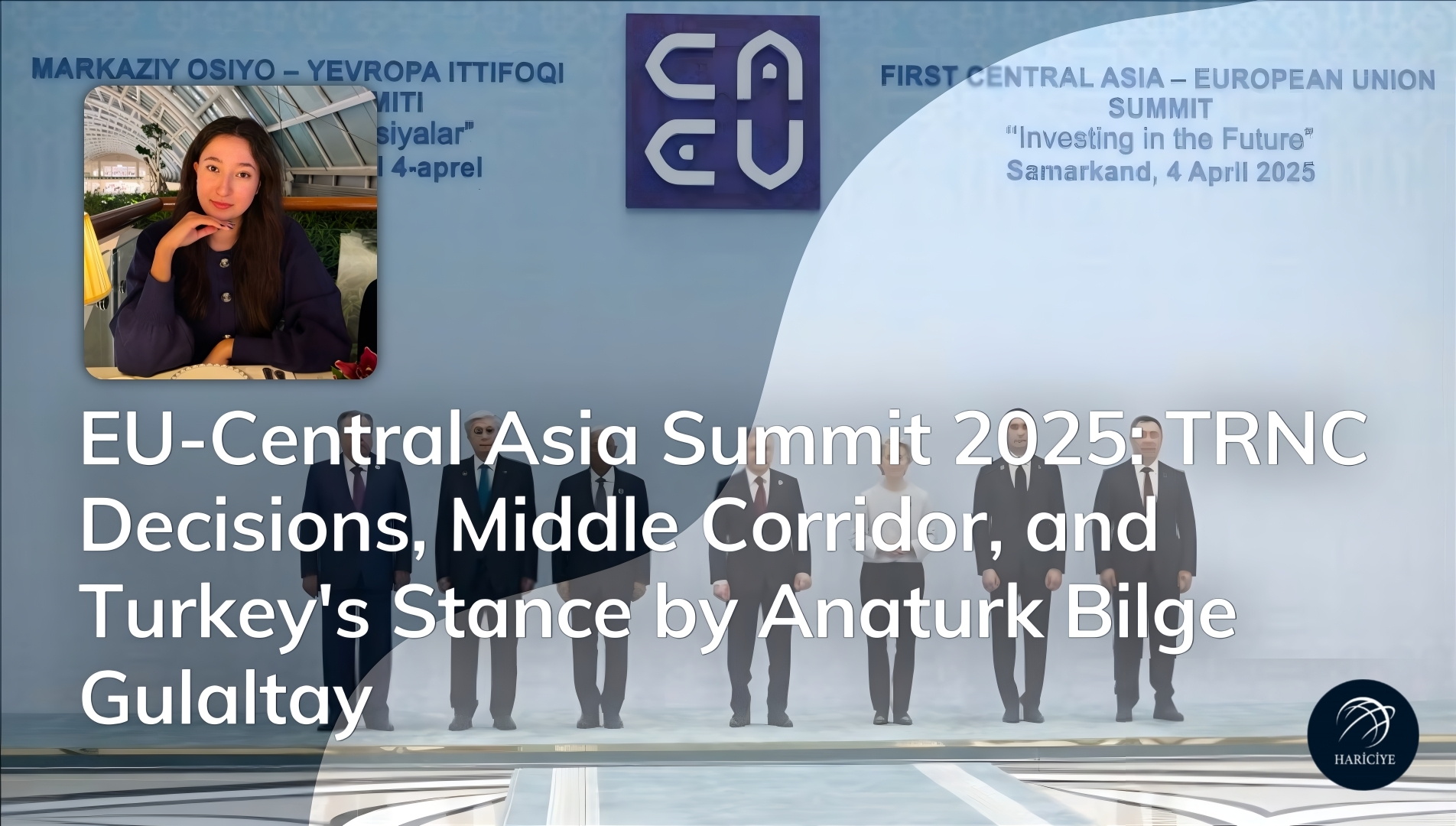
On April 4, 2025, the First European Union-Central Asia Summit held in Samarkand, Uzbekistan, paved the way for critical diplomatic outcomes. In the summit’s joint statement, countries such as Kazakhstan, Turkmenistan, and Uzbekistan once again confirmed their commitment to the 1983 and 1984 UN Security Council resolutions 541 and 550 regarding the Turkish Republic of Northern Cyprus (TRNC). These resolutions declare the TRNC, recognized by Turkey, to be illegal and call for the non-recognition of any government on the island other than the Republic of Cyprus (Southern Cyprus). Thus, the Central Asian countries clearly stated at the summit that they would not recognize the TRNC and would act by international law. Interestingly, Turkey chose not to criticize this development openly.
Diplomatic Background and Central Asian Countries’ Relations with the EU
The EU-Central Asia Summit is the result of a long-standing rapprochement. Since the collapse of the Soviet Union, the EU has been working to strengthen its political and economic ties with countries in the region, such as Kazakhstan, Uzbekistan, Turkmenistan, Kyrgyzstan, and Tajikistan. In particular, the Russia-Ukraine War, which erupted in 2022, accelerated the EU’s strategic focus on Central Asia. Indeed, as the traditional northern trade route (via Russia) has become risky, Central Asian countries are seeking alternative trade routes to Russia and seeking to reduce their unilateral dependence. In this context, the EU upgraded relations to a “strategic partnership” by holding its first regional leaders’ summit in 2025. António Costa attended the summit on behalf of the EU Council and European Commission President Ursula von der Leyen, and Uzbekistan President Shavkat Mirziyoyev hosted the event.
The EU announced a €12 billion investment package for Central Asia at the summit. This investment is expected to support the region’s infrastructure, energy, and digitalization projects as part of the EU’s Global Gateway initiative. Countries such as Kazakhstan, Uzbekistan, and Turkmenistan also agreed to consider the EU’s political sensitivities in exchange for deepening economic cooperation with Europe. Indeed, in the final declaration of the Samarkand Summit, the parties emphasized their commitment to the UN Charter and internationally recognized borders, as well as the sovereignty and territorial integrity of all states. In this context, a strong commitment to UN Security Council Resolutions 541 and 550, which refer to the Cyprus issue, was expressed, and support was given to the UN position that the TRNC should not be recognized.
This diplomatic step shows that Central Asian countries are opening a new page in their relations with the EU. Kazakhstan, Central Asia’s largest economy, has long been in contact with the EU on energy trade (oil exports) and investments. An Enhanced Partnership Agreement is currently in place between Kazakhstan and the EU, and the Astana administration is developing alternatives via the Caspian Sea for oil shipments to Europe outside Russia. After years of isolation, Uzbekistan has been pursuing a reformist policy since 2016 and has moved closer to the EU; it values EU support in trade, investment, and infrastructure projects. Despite its “permanent neutrality” policy, Turkmenistan is on the EU’s radar due to its massive natural gas reserves. For years, Europe has warmly considered transporting Turkmen gas to Turkey and Europe via the Trans-Caspian Pipeline through Azerbaijan. Indeed, signing a memorandum of understanding on this issue at the Azerbaijan-Turkey-Turkmenistan summit in December 2022 was described as a “historic initiative.” These developments show that Central Asian states are pursuing a pragmatic balance policy in their relations with the EU. While maintaining ties with Russia and China, they also pursue multi-faceted diplomacy by establishing economic partnerships with the West.
The Cyprus issue has become a test of merit for these countries moving closer to the EU. The Greek Cypriot Administration (Republic of Cyprus), a member of the EU, has long sought diplomatic recognition from Central Asian states. At the end of 2023 and the beginning of 2024, rapid steps were taken in this direction: Uzbekistan accredited its ambassador to Italy to the Republic of Cyprus in December 2024. Kazakhstan also decided to establish diplomatic relations with the Republic of Cyprus in January 2025 and appointed ambassadors to each other. Turkmenistan announced that it had accredited its ambassador to Italy to Cyprus. Even Kyrgyzstan joined the list of countries that appointed ambassadors to the Republic of Cyprus in April 2025. Completing these steps before the EU-Central Asia Summit on April 4, 2025, was considered significant. Indeed, TRNC President Ersin Tatar commented that Turkish states acted this way due to their close relations with the EU, saying, “They can establish relations with Southern Cyprus, but we expect that similar relations be established with the TRNC.” In conclusion, the Central Asian countries have shown that they are willing to take a different stance from Turkey on the Cyprus issue to deepen their cooperation with the EU. This situation reveals that Turkey’s long-standing calls to recognize the TRNC have not been heeded even by its close allies.
Turkey’s Silence: Why Did It Not React Openly?
Despite being the country with the highest sensitivity on the Cyprus issue, Turkey remained conspicuously silent at the Samarkand Summit regarding the commitment of its Turkish allies not to recognize the TRNC. No harsh response came from Ankara at the official level; neither the Ministry of Foreign Affairs nor senior government officials made statements directly condemning the Central Asian countries. The reasons for this diplomatic silence can be evaluated under several headings:
• Prior Information and Diplomatic Consultation: Turkey probably anticipated these developments. Reports that Kazakhstan and others would appoint ambassadors to the GKRY had been circulating for months. Ankara may have been aware of these decisions behind the scenes and conveyed its objections through diplomatic channels but avoided open confrontation. Some commentators in the TRNC said that “the Turkish republics signed these decisions without knowing about them,” pointed to Ankara’s lack of response and argued that Turkish diplomacy was caught unprepared. They also emphasized that the stance of the Central Asian countries should be understood, saying that “world realities are forcing them to behave this way.”
• The Organization of Turkic States and the Concept of Brotherhood: These three countries are members of the Organization of Turkic States (OTS), established under Turkey’s leadership, and are referred to as “brother countries”. Last year, the TRNC was accepted as an observer member of the OTS, which Ankara presented as a victory on the road to recognition for the TRNC. Therefore, although the commitment of these countries not to recognize the TRNC concerning UN resolutions is a diplomatic disappointment for Ankara, Turkey chose to remain silent so as to not damage the image of the brotherhood. The Turkish government may have calculated that criticizing Central Asian leaders in public would harm the solidarity of the Turkish world. Indeed, some segments in the TRNC demanded a tougher stance from Ankara, stating, “We cannot accept steps that undermine our solidarity with the Turkish world”; however, Ankara did not respond to these calls.
• The Big Strategic Picture – The Middle Corridor and Geopolitical Priorities: The most crucial reason for Turkey’s lack of response is its desire not to jeopardize its primary strategic interests. Issues such as the Middle Corridor project (Trans-Caspian trade route) and energy cooperation (especially the delivery of Turkmen gas to Turkey), which connect Central Asia and Turkey, are vital to Ankara. Disagreeing and fighting with these countries over the TRNC issue could have harmed broader economic and geopolitical goals. Ankara appears to have chosen to be flexible on the Cyprus issue to preserve regional cooperation and trade networks. In other words, geopolitical priorities have overshadowed sensitivities, and Turkey has accepted concessions on the TRNC issue in favor of priorities such as the Middle Corridor and the Energy Corridor.
• Awareness of International Isolation: Turkey has long been aware that it stands alone in the international arena on the Cyprus issue. Faced with the reality that it is the only country that recognizes the TRNC, while the UN and the EU take the opposite stance, Ankara occasionally shows diplomatic flexibility. Seeing that its friendly countries in Central Asia also act in line with the global consensus, it may have calculated that taking a hard line would not bring any gains. Otherwise, escalating the issue would make Turkey’s isolation more visible, straining its relations with its allies and putting its ties with the EU at risk. Indeed, in contrast to Turkey’s silence, the opposition and some media outlets reacted strongly to the situation. Opposition newspapers ran headlines such as “Turkish states signed a scandalous agreement with the EU,” claiming that the TRNC had been disregarded for 12 billion euros. Some even used harshly critical phrases like “they sold the TRNC.” However, the government did not amplify these criticisms, and the issue was brushed aside without gaining much traction in the public discourse.
In summary, Ankara’s lack of response can be interpreted as strategic silence. This approach is consistent with the multidimensional interests that Turkish foreign policy has prioritized in recent years. Turkey disregarded this step to maintain its leadership position within the Turkish world, continue its influence in Central Asia, and not undermine regional projects. This situation can also be interpreted as a sign that Turkey has adopted a realistic rather than emotional approach to foreign policy.
The Importance of the Middle Corridor Project for Turkey’s Interests
Turkey’s willingness to take a back seat even on such a sensitive issue lies in its importance to large-scale geo-economic projects such as the Middle Corridor. The Middle Corridor (Trans-Caspian East-West Middle Corridor) is a multimodal (rail-sea-road) trade route that extends from China through Central Asia, across the Caspian Sea, and via the Caucasus and Turkey to Europe. This route is a modern interpretation of the historic Silk Road and is a strategic initiative that turns Turkey’s geographical location into an advantage. The Republic of Turkey also considers strengthening ties with Central Asia a foreign policy priority under its “Asia Anew” initiative. The Middle Corridor initiative has gained international support by advancing in line with China’s Belt and Road Initiative (BRI), launched in 2015.
The diplomatic and economic advantages the Middle Corridor offers to Turkey are multidimensional. First and foremost, this corridor represents a vital transit role for Turkey, which aims to become a transportation and trade hub. Today, most of this trade is carried out by sea via Suez or Russia (Trans-Siberian route). Still, Turkey could attract a significant portion of this traffic if the Middle Corridor becomes fully operational. The Russian route, known as the Northern Corridor, has lost its reliability due to the war in Ukraine.
In contrast, the Iranian route, known as the Southern Corridor, remains limited due to sanctions. Under these conditions, the Middle Corridor is the “safest and shortest route.” This route, which passes through Turkey, is 2,000 km shorter than the northern route and is more favorable in climate and geographical conditions; it can reduce transportation time by one-third compared to sea transport. Therefore, the Middle Corridor means logistical superiority for Turkey.
Economically, projects along the Middle Corridor route promise Turkey significant investments and revenue opportunities. As new railways, ports, and logistics centers are constructed, Turkish construction companies, logistics firms, and port operators are securing their share of this pie. For example, plans to establish logistics centers and free trade zones in the ports of Aktau and Turkmenbashi on the eastern shore of the Caspian Sea will deepen Trans-Caspian cooperation while increasing Turkey’s commercial access. This means the modernization of the country’s internal infrastructure, which will also boost the industrial and export sectors in the long term.
The Middle Corridor is a trade route and a trump card in foreign policy. Thanks to this route, Turkey is strengthening its position in the East and West. While offering an indispensable route for China and Central Asia in the East, it is becoming a valuable partner for Europe in the West, bypassing Russia. This situation provides Ankara with geopolitical maneuvering space. For example, Europe’s goal of establishing connections with Central Asia inevitably includes Turkey in the equation. Indeed, the EU’s €12 billion investment plan for Central Asia indirectly includes improving the infrastructure of the Middle Corridor, which extends to Europe via Turkey. Turkey’s central role in this project also constitutes a strategic value in its relations with the EU.
Potential Economic Impacts of the Middle Corridor on Turkey and Central Asia
The Middle Corridor route holds serious economic opportunities and transformation potential for Turkey and Central Asian states. With the steps taken in recent years, the concrete results of this potential have begun to emerge. In particular, transportation on the corridor has rapidly increased after the Russia-Ukraine War. In 2023, the volume of cargo transported via the Trans-Caspian route was 2.7 million tons; in 2024, it reached 4.1 million tons. This represents an enormous growth that will multiply the transportation capacity and trade volume of Turkey and the countries in the region.
The economic impacts on Turkey can be examined in several dimensions:
• Increase in Trade Volume: The Middle Corridor will accelerate Turkey’s exports to Central Asia, China, and South Asia, enabling it to import raw materials and products at lower costs. The rapid flow of cargo by rail and road allows Turkish exporters to ship goods to East Asia in less time than sea transport. This increases competitiveness. Similarly, Central Asian countries can diversify their foreign trade by transporting their products to Europe more easily via Turkey. For example, Kazakhstan’s petrochemical products or Uzbekistan’s textile and agricultural products will be able to enter the European market more quickly thanks to the Middle Corridor.
• Infrastructure Investments and Industry: Huge investments are being made to operationalize the Middle Corridor. These include railway modernization, new lines (such as the China-Kyrgyzstan-Uzbekistan railway project for Central Asian internal connections), expansion of ferry fleets in the Caspian Sea, and modern facilities at border gates. The EU’s announced package of 12 billion euros will likely include grants and loans for digital infrastructure, green energy, and transportation corridors. China already provides large regional loans under the Belt and Road Initiative. These investments will accelerate Central Asia’s development while delivering new projects for Turkish contractors. Furthermore, as transportation becomes easier, industrial investments may shift to countries along the route; for example, a European company may build a factory in Kazakhstan instead of Russia and ship its products to Europe via the Middle Corridor. In such a scenario, Turkey and Central Asian countries will assume a more central position in global supply chains.
In summary, the full implementation of the Middle Corridor could open a new era for the economies of Turkey and Central Asia. As the direction and volume of trade flows change, economic ties between regional countries will also strengthen. This will increase prosperity, technology transfer, and regional development. Of course, the removal of bureaucratic obstacles, the acceleration of customs procedures, and the maintenance of regional stability are essential for the project’s success. Indeed, the Joint Cooperation Protocol and coordination mechanisms signed between the transportation ministers within the Organization of Turkic States are in place to overcome these obstacles.
Thanks to the project, Turkey can pursue win-win diplomacy with the countries in the region, offering them concrete economic benefits while achieving its own geo-economic goals. Thus, relations are becoming sustainable beyond historical and cultural ties through joint projects and mutual dependence. Turkey’s silence on the TRNC issue also makes sense in this context: In the larger strategic picture of the Middle Corridor, Ankara has chosen to gain rather than lose its friends and has been careful not to undermine its vision of integration with the Turkic world. In the long term, the success of the Middle Corridor will enable Turkey to have a say in the Eurasian power balance and continue to offer Central Asian countries a strong alternative to the Russia-China axis.